


Young Minds Take Flight At The Vermilion Airport

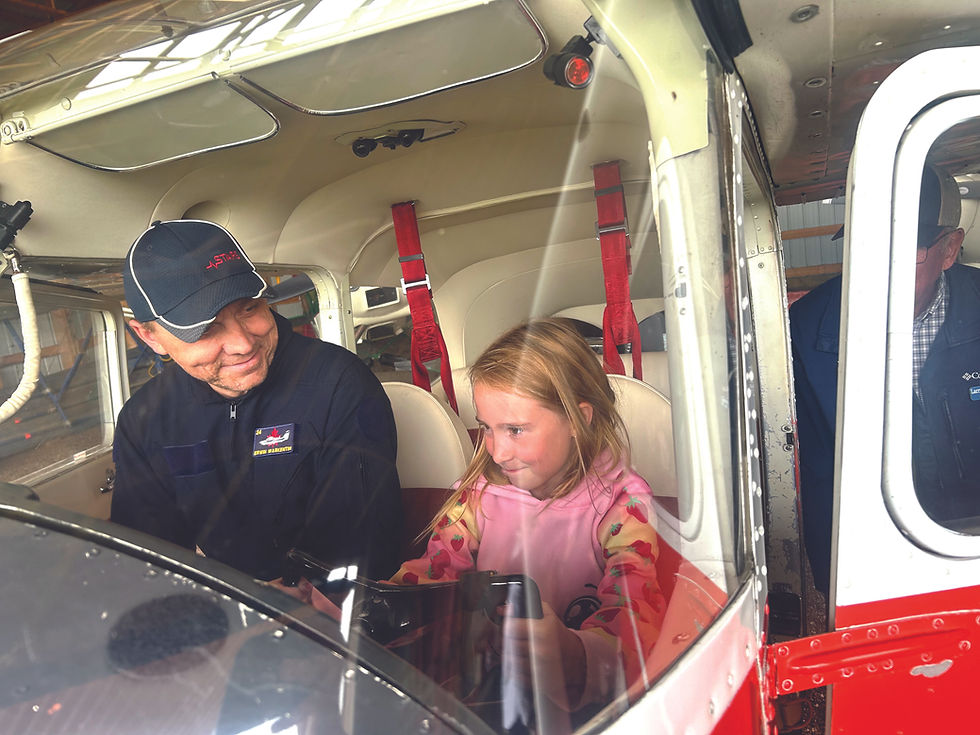
The skies may have remained calm on August 13, but excitement was soaring as the Vermilion River Flying Club welcomed children from Brighter Beginnings programs for an educational and interactive visit to the Vermilion Airport.
The field trip was designed with the young visitors in mind, giving children between the ages of five and 10 an opportunity to get an up-close look at airplanes while learning some of the basics of aviation.
The children were welcomed by club members and pilots Erwin Warkentin and Larry Bingham and retired pilot Steve, who shared their aviation knowledge and experience with the eager group.
Warkentin began by explaining that there are many different ways people can become involved in aviation.
“We have pilots like Larry who fly for fun, I teach people how to fly, and Steve is a big aviation and airplane enthusiast,” Warkentin told the children, with Steve adding that he is a former pilot.
As the group made its way to the aircraft, Warkentin introduced the children to the hangars and their purpose.
“Kids, these big buildings are called hangars, and that is where we store airplanes,” he explained.
Inside, the visit quickly became interactive as Warkentin tested the children’s aviation knowledge. Pointing to the blade at the front of an airplane, he asked if anyone knew what it was called. Hands quickly went into the air, with one child correctly identifying it as the propeller.
When Warkentin asked what the propeller does, the answers came just as quickly.
“It spins around,” one child offered, while another said, “It turns.”
Warkentin explained that an airplane propeller works somewhat like the propeller on a boat. While a boat’s propeller pushes it through the water, an airplane’s propeller pulls the aircraft forward, helping it move through the air.
The lesson continued as Warkentin ran his hand along one of the airplane’s wings and asked the children if they knew what the structure was called.
“It makes it fly straight,” one youngster answered.
While agreeing that it plays an important role in flight, Warkentin asked again what the structure itself was called.
“It’s the wings!” another child enthusiastically replied.
As Warkentin and Bingham guided the children around the aircraft, they pointed out other components, including the windows, wheels and landing gear.
When one child identified the tail of the aircraft, Warkentin explained just how important that section of the plane is.
“I heard a young lady say it helps us fly straight, and she is correct. The tail does that very important job,” he said. “Without our vertical stabilizer or rudder, this plane would spin around and around. We wouldn’t be able to fly straight.”
One youngster quickly suggested that spinning around might be fun, prompting Warkentin to reply with a smile that it might be — if it could be done safely.
Another child pointed out what they called the “back wing,” giving Warkentin an opportunity to introduce the group to some more advanced aviation terminology.
“At the back, there is a horizontal stabilizer, a vertical stabilizer, and a movable part called the elevator, which controls up-and-down motion,” he explained. “All together, those pieces make up what we call the empennage. Without it, the airplane would spin sideways or in circles, so it is a very important part.”
Warkentin and Bingham also demonstrated how the wing flaps move and explained the role they play in helping an aircraft take off and land safely.
Throughout the visit, the children eagerly asked questions, pointed out parts of the aircraft and soaked up the information being shared. Their curiosity eventually led one youngster to ask whether a baby could fly an airplane.
Warkentin explained that while a baby may not be able to take the controls, some of the children were not all that far away from being old enough to begin learning how to fly — a revelation that immediately captured their attention.
By the end of the tour, the young visitors had done much more than simply see an airplane up close. They had been introduced to the science and mechanics behind flight while learning from people with firsthand aviation experience.
For the Vermilion River Flying Club, the visit was also an opportunity to introduce a new generation to the world of aviation. For some of the young visitors, the experience may have planted a seed that could one day bring them back to the airport — perhaps next time in the pilot’s seat.


Comments